Though it’s been a few years now since ChatGPT’s public release and the generative AI boom, in Utility 2030’s discussions with our members and other utilities, we’ve found that adoption of AI within utilities has been somewhat uneven. Some utilities are integrating it into their processes, but many are not using AI at all. This is unsurprising, as utilities are particularly risk averse organizations and have to be especially prudent when it comes to security of their systems.
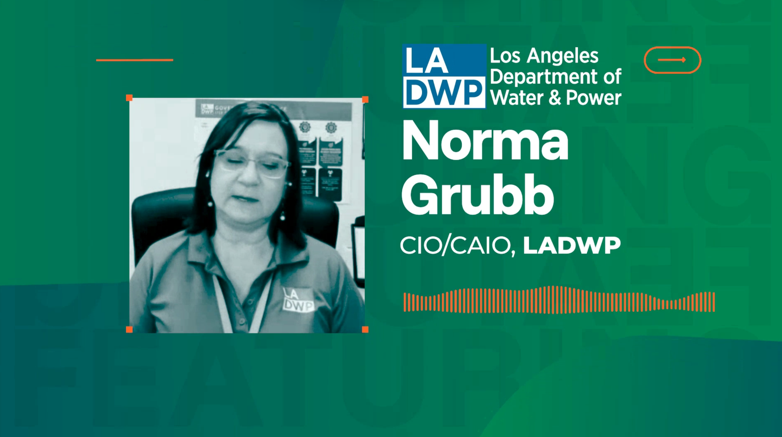
We recently spoke with Norma Grubb, Chief Technology Officer and Chief AI Officer at LADWP, who unlike many people using AI in a professional environment, has extensive training in the technology. Norma wrote her dissertation for her doctoral degree on artificial intelligence in 2018, then went on to teach AI and Machine Learning at Syracuse University and Purdue University. In 2024, she also obtained a certification in AI Governance from the International Association of Privacy Professionals.
AI governance is an area she is passionate about and where she believes there are opportunities to enable widespread use of AI, rather than hinder it with guardrails that discourage innovation.
At LADWP employees are encouraged to use and experiment with AI in their jobs, in particular, with Microsoft Copilot. Since they know their Microsoft environment is secure, and governance is applied upfront to ensure the tool is safe, any employee who requests one is given a Copilot license, with the only caveat being that they participate in peer to peer ‘communities of practice’ where they share about their experiences with AI. Norma has found that the positive impacts of sharing in these groups are twofold: they break down some fears or hesitations around using AI, and colleagues gain more education about the technology from each other.
Like Bashir Bseirani in our first UNFILTERED interview, Norma emphasized the importance of maintaining that human agency is always at the center of AI; that people understand it sometimes produces inconsistencies and inaccurate information. Within the organization, she says, “we are raising awareness that AI is your tool, and whatever you do with your tool is your responsibility. Microsoft calls it Copilot, not autopilot, so you are still the pilot of this innovation plane.”
As the utility sector continues to navigate the complexities of AI adoption, LADWP’s approach has shown that innovation doesn’t have to come at the expense of security. Applying governance before putting AI into employees’ hands, along with fostering a culture of collaboration and accountability, can reduce some of the risks associated with AI and, in Norma’s words, “increase human agency rather than compete with it.”